Small Business KPIs: What to Track and Why

Most small business owners fall into one of two camps. Either they track nothing — running on gut feel and checking their bank balance when it gets scary — or they track everything, drowning in spreadsheets full of numbers that don't change any decisions.
Both approaches waste your time. The fix is knowing which handful of numbers actually tell you whether your business is healthy, growing, or headed for trouble.
Here are the 7 KPIs that matter for a small business or freelance operation, why each one matters, and how to track them without it becoming a second job.
What's a KPI, and Why Should You Care?
KPI stands for Key Performance Indicator. The key word is "key" — not every metric is a KPI. Your Instagram follower count is a metric. Your monthly revenue is a KPI. The difference is whether the number drives a decision. If it goes up or down and you wouldn't do anything differently, it's not a KPI.
For small businesses, you need between 5 and 8 KPIs. Fewer than that and you're flying blind. More than that and you'll stop looking at any of them.
The 7 KPIs That Actually Matter
1. Monthly Revenue
This is the big one. Not projected revenue, not invoiced revenue — actual cash received this month. Track it the same way every month so you can compare January to February without guessing.
If you want to go one level deeper, break it down by revenue source. Freelancers might split it into Client A, Client B, and product sales. Service businesses might split by service type. This takes 30 extra seconds per entry and tells you where your money actually comes from.
2. Monthly Expenses (by Category)
Total spending matters, but what you're spending on matters more. Five categories cover most small businesses: tools and software, marketing, supplies, contractors, and "everything else."
If you're filing a Schedule C, your expense tracker should map directly to IRS categories — that's a tax time lifesaver. I wrote a full breakdown of how to set that up in my post on tracking business expenses without an accountant.
3. Profit Margin
Revenue minus expenses, divided by revenue. That's it. This single number tells you whether your business is sustainable.
A service business should aim for 50-70% margins. Product businesses vary wildly, but if you're consistently below 20%, something is off — either your pricing is too low or your costs are too high. The important thing is tracking the trend. A margin that's dropping month over month is a five-alarm fire, even if the number itself looks okay today.
4. Cash Flow (Money In vs. Money Out by Week)
Profit margin tells you the big picture. Cash flow tells you whether you can pay your bills next Friday. A business can be profitable on paper and still go under because the money comes in 60 days after the expenses go out.
Track this weekly: what came in, what went out, what's the balance. If you see a pattern where week 3 of every month is tight, you can fix it — adjust your invoicing terms, stagger your expenses, or build a cash buffer.
5. Client Acquisition Rate
How many new clients or customers did you add this month? This is the leading indicator that most small businesses ignore. Revenue is a trailing indicator — it tells you what already happened. Client acquisition rate tells you what's about to happen.
If you added 5 new clients a month for the last three months and suddenly you added 1, your revenue is about to drop. Seeing that early gives you time to react — ramp up marketing, ask for referrals, or adjust pricing.
6. Average Revenue Per Client
Total revenue divided by number of active clients. This tells you whether you're growing by adding more clients or by increasing value per client. Both work, but they require very different strategies.
If this number is flat or declining, you may be attracting lower-value work, or your pricing hasn't kept up with the value you deliver. If you're a freelancer, this is directly tied to your rates — I covered how to think about pricing in my post on tools every freelancer needs.
7. Outstanding Invoices (Accounts Receivable)
Money that's been billed but not received. This is the KPI most freelancers forget until it bites them. If you have $8,000 in outstanding invoices and $2,000 in the bank, you're not as healthy as you think.
Track how much is outstanding, how long it's been outstanding, and who the repeat offenders are. A simple invoicing system with built-in payment tracking prevents invoices from falling through the cracks.
How to Track These Without Losing Your Mind
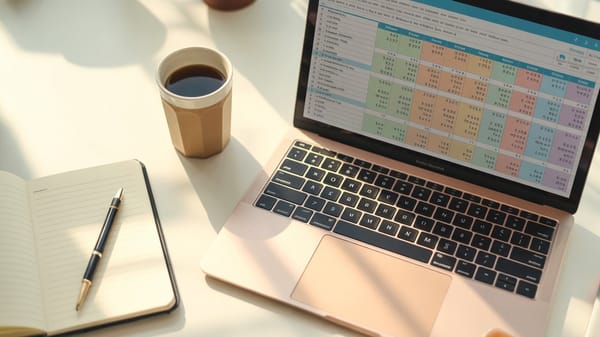
You don't need Tableau. You don't need a BI platform. You need a single spreadsheet with a dashboard tab that pulls from your data entry tabs.
Here's the minimum setup: one tab for revenue entries (date, source, amount), one tab for expense entries (date, category, amount), and one dashboard tab with formulas that calculate everything above automatically. Open it once a week, spend 15 minutes entering numbers and reviewing the dashboard. That's it.
The Small Business Revenue & Expense Tracker Pro is built exactly this way — separate entry tabs feed a visual dashboard with monthly trends, category breakdowns, and a financial health check. It runs on Google Sheets or Excel, costs $29 one time, and takes about 5 minutes to set up.
If you're building your own, the key is keeping the data entry as simple as possible. Every extra field you add is friction that makes you skip a week, then a month, then you're back to checking your bank balance and hoping for the best.
The Weekly Review That Ties It All Together
The KPIs only work if you look at them. Block 15 minutes every Monday morning — before you start working — and answer these four questions:
- Am I on track for my monthly revenue target?
- Is any expense category growing faster than revenue?
- Are new clients coming in at a healthy rate?
- Is anything outstanding that I need to follow up on?
If all four answers are good, close the spreadsheet and get back to work. If something's off, you caught it early enough to fix it. That's the entire point.
A good external SSD like the Samsung T7 means your tracking spreadsheet — and everything else — has a reliable backup that isn't dependent on cloud access.
Start With What You Have
You don't need to set up all 7 KPIs today. Start with revenue and expenses — those two alone put you ahead of most small businesses. Add profit margin next. Then layer in the rest over the next few weeks.
The businesses that succeed long-term aren't the ones with the fanciest dashboards. They're the ones that consistently look at a few key numbers and make decisions based on what they see.
Want more practical business tips delivered every Tuesday? Subscribe to The Data Brief — one tip, one tool, zero fluff.